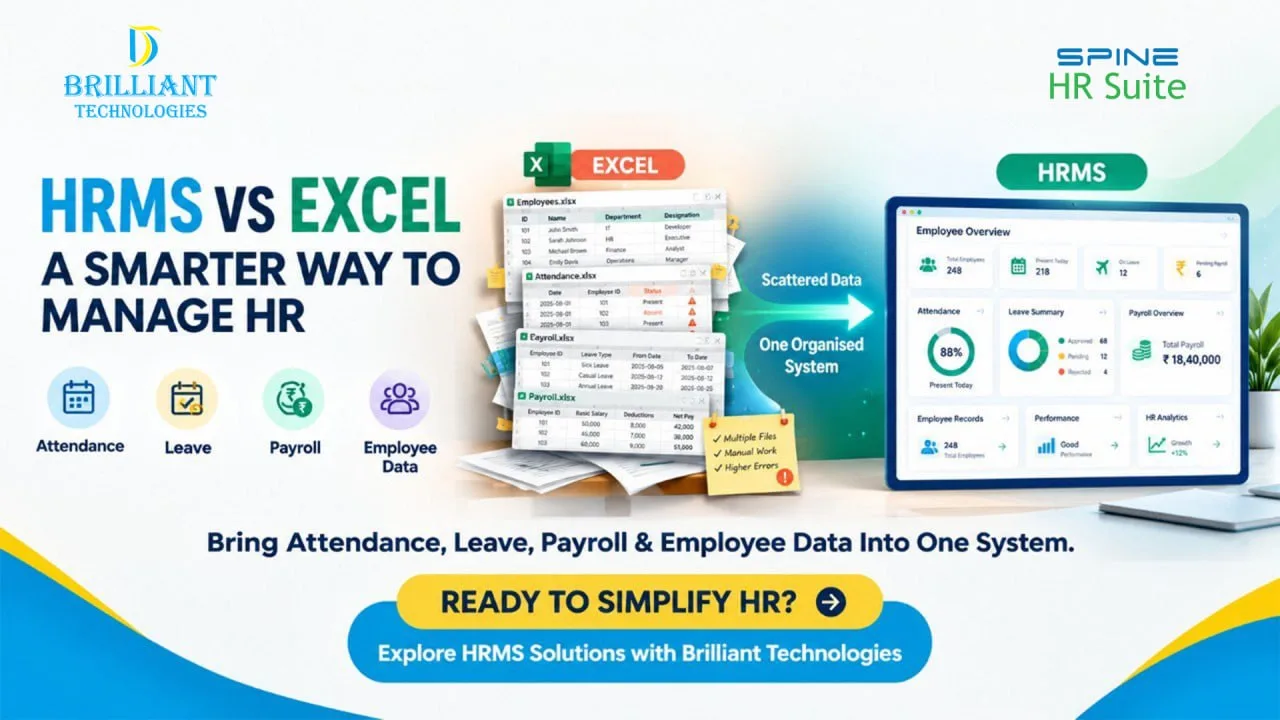
Excel has been a convenient way for businesses to keep track of employee information, attendance, leave, payroll details, and HR reports. It is simple to set up and works well when the amount of data is small. But as a company grows, HR teams often find themselves working with multiple spreadsheets, repeated entries, and calculations that take more time than expected.
This is where HRMS software can offer a more practical approach. Instead of managing different HR activities across separate files, businesses can bring them together in one system. This makes everyday HR work easier to organise and reduces the amount of manual effort involved.
So, why are businesses moving from Excel to HRMS? The answer comes down to better organisation, automation, easier access to information, and less repetitive work.
Why Choose HRMS Over Excel for HR Management?
Excel can handle basic employee records, but managing an entire HR process through spreadsheets can become difficult over time. Attendance, leave, payroll, employee information, approvals, and reports may all require separate files or manual updates.
With an HRMS, these activities can be connected within a single platform. HR teams can maintain employee information, manage attendance and leave, process payroll, and handle employee requests without constantly switching between spreadsheets.
For growing organisations, this can make HR operations more structured and easier to manage.
1. Spend Less Time on Manual Calculations
HR teams deal with many calculations throughout the month. Working days, attendance, leave balances, salary components, deductions, and payroll figures all need to be checked carefully.
When these calculations depend heavily on Excel formulas, even a small change in the underlying data may require additional checking.
An HR automation software solution can take care of many repetitive calculations based on the rules configured in the system. This reduces routine work and allows HR professionals to spend more time on activities that require their attention.
For companies with a growing workforce, automated HR calculations can make a noticeable difference.
2. Make Payroll Processing More Organised
Payroll is one area where accuracy and consistency matter every month. HR teams need to consider attendance, leave, salary structures, deductions, and other employee details before processing salaries.
When this information is spread across multiple Excel sheets, collecting and checking the required data can take considerable time.
With HRMS payroll software, payroll information can be managed within a connected HR environment. Depending on the solution, businesses can handle salary processing, payslips, deductions, and payroll reports more efficiently.
For organisations looking for HRMS for payroll calculations, this can reduce the amount of repetitive work involved in monthly payroll activities.
3. Simplify Attendance and Leave Management
Managing attendance and leave manually becomes increasingly difficult as the number of employees increases. Different shifts, leave policies, locations, and approval processes can add to the workload.
An HRMS can bring attendance tracking and leave management into the same system. Employees can submit requests, managers can review them, and HR can maintain the relevant records without depending on several spreadsheets.
With automated attendance management and automated leave management, routine HR activities can become much easier to track.
4. Keep Employee Records in One Place
Searching through different spreadsheets for employee information can be frustrating, particularly when HR teams need information quickly.
A centralised employee data management system provides one place for maintaining important employee details. Depending on the HRMS, this may include personal information, job details, attendance, leave, payroll, performance, and other employment-related records.
Having information organised in one system can also help reduce duplicate entries and unnecessary data handling.
5. Reduce Dependence on Multiple Excel Files
Excel itself is not the problem. It becomes challenging when spreadsheets are being used to manage almost every HR activity.
Different versions of the same file, manual updates, copied formulas, and files shared between teams can make it difficult to know which information is current.
Moving from Excel to HRMS gives businesses a more structured way to manage HR workflows. Instead of maintaining several spreadsheets, HR teams can work with information through a central system.
6. Get Better Visibility Into HR Data
HR teams and managers need access to useful information, not just stored records.
An HR management software solution can help organise information related to attendance, leave, payroll, employees, and other HR activities. Depending on the reporting capabilities, HR teams can generate reports without spending hours collecting information from different files.
Better access to HR data can also help managers understand workforce trends and make decisions with greater confidence.
7. Give Employees More Control Through Self-Service
Not every employee request needs HR intervention.
With Employee Self Service (ESS), employees may be able to view relevant information, submit leave requests, check attendance, access payslips, and complete other routine activities themselves, depending on the features available in the HRMS.
This can reduce repetitive queries for HR teams while giving employees a more convenient way to manage everyday HR requirements.
Why Consider HRMS Software in Hyderabad?
For businesses searching for HRMS Software Hyderabad solutions, choosing the right platform is about more than simply replacing Excel.
Growing companies may need payroll management, attendance, leave, employee self-service, reporting, and workflow automation in one solution. This is why businesses comparing HRMS Software Providers Hyderabad options should look at the overall fit rather than choosing software based only on the number of features.
Implementation support, ease of use, scalability, employee adoption, and ongoing assistance are also important factors.
Businesses looking for HRMS Solutions Hyderabad can start by identifying which HR processes currently take the most time. This makes it easier to choose a solution that addresses actual day-to-day requirements.
What Should You Check Before Moving From Excel to HRMS?
Before investing in an HRMS, take a close look at your existing HR process.
Ask yourself:
- How much time does the HR team spend preparing payroll?
- Are attendance and leave records maintained manually?
- Are several Excel files being used for the same employees?
- How often do HR calculations need to be checked?
- Do employees frequently contact HR for routine requests?
- Does management need faster access to HR reports?
- Would a central employee database make daily work easier?
The answers can help you identify where HR workflow automation can bring the most value.
Conclusion
Excel can continue to be useful for simple HR tasks, but it can become difficult to manage when employee numbers and HR responsibilities increase. An HRMS provides a more organised way to handle employee information, attendance, leave, payroll, reporting, and everyday HR requests.
For businesses looking for HRMS Software in Hyderabad, Payroll Management Software Hyderabad, or Employee Management Software Hyderabad, the real goal is not simply to stop using Excel. It is to make HR work easier, reduce repetitive tasks, and give employees and managers better access to the information they need.
Brilliant Technologies helps businesses identify technology solutions that fit their operational needs. With the right HRMS solution for businesses, organisations can reduce their dependence on manual spreadsheets and move towards a more organised, efficient approach to HR management.
Frequently Asked Questions
What are the benefits of using HRMS instead of Excel?
The main benefits are reduced manual work, better employee data management, easier payroll processing, simpler attendance and leave tracking, improved reporting, and less dependence on multiple spreadsheets.
Is HRMS better than Excel for employee management?
For growing businesses, an HRMS can provide a more organised way to manage employee information and connect different HR activities compared with maintaining multiple Excel files.
How does HRMS reduce manual HR work?
HRMS can automate repetitive activities such as attendance tracking, leave workflows, payroll processing, employee records, and reporting, depending on the features included in the software.
Can HRMS automate payroll calculations?
Yes. An HRMS with payroll functionality can use employee, attendance, leave, and salary information to support various payroll calculations and processes.
What should businesses look for in HRMS software?
Businesses should consider their employee strength, payroll requirements, attendance and leave processes, reporting needs, self-service requirements, implementation support, scalability, and ongoing assistance.
Which HRMS software is suitable for businesses in Hyderabad?
There is no single solution that suits every organisation. Businesses comparing Best HRMS Software in Hyderabad options should choose a platform based on their workforce size, HR requirements, features, implementation support, and long-term business needs.
Ready to Switch from Excel to HRMS?
Get Your HRMS Demo Today.